
Why does one temple in the heart of Luxor feel unlike every other monument in Egypt — no tombs, no dead kings, just a building alive with light? Luxor Temple was never made for the afterlife. It was built to renew the living power of the pharaoh, and it still glows for it after dark.
Quick Answer: Luxor Temple stands in the center of modern Luxor on the Nile’s East Bank, built mainly by Amenhotep III and Ramesses II. Unlike other temples, it honored the renewal of kingship, not a single god or tomb. Allow 1.5–2 hours, and come after sunset — it is one of the few sites even better by night.
Plan Your Visit: Luxor Temple at a Glance
Everything you need before you go — timing, cost, and the best hour to arrive:
| Detail | What to know |
|---|---|
| Location | Central Luxor, East Bank — walkable from the corniche hotels |
| Built by | Amenhotep III & Ramesses II, with a chamber added by Alexander the Great |
| Opening hours | 6:00 AM – 10:00 PM (stays open late — the key to the night visit) |
| Entry fee | From about EGP 400 for foreign visitors (check locally — prices change) |
| Best time | After sunset, when the columns are floodlit |
| Time needed | 1.5–2 hours |
| Good to know | An 800-year-old working mosque sits inside the temple walls |
What Should You Look for Inside?
Luxor Temple rewards travelers who know where to look. Prioritize these:
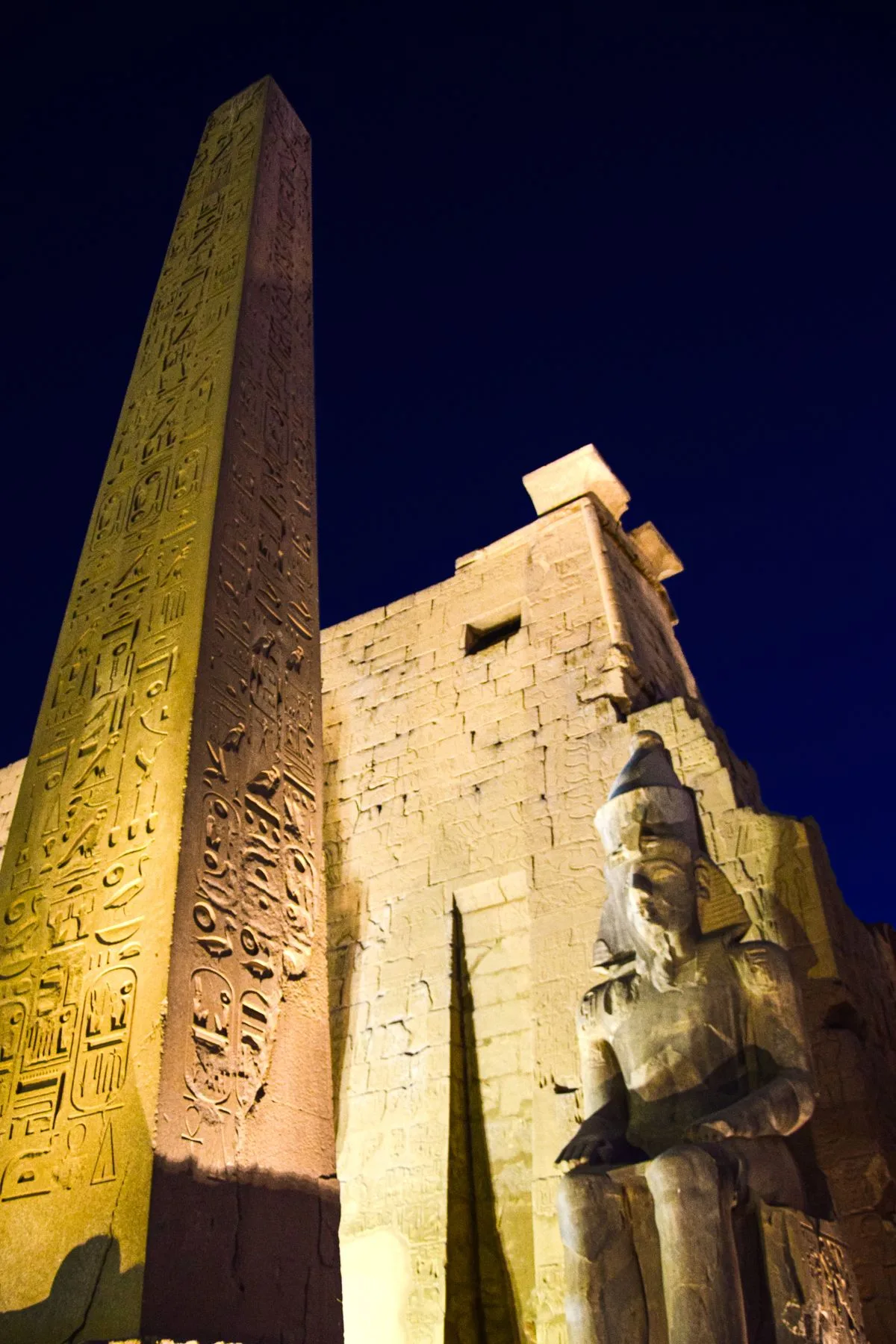
- The single standing obelisk — its twin is not lost; it stands in Paris (more on that below).
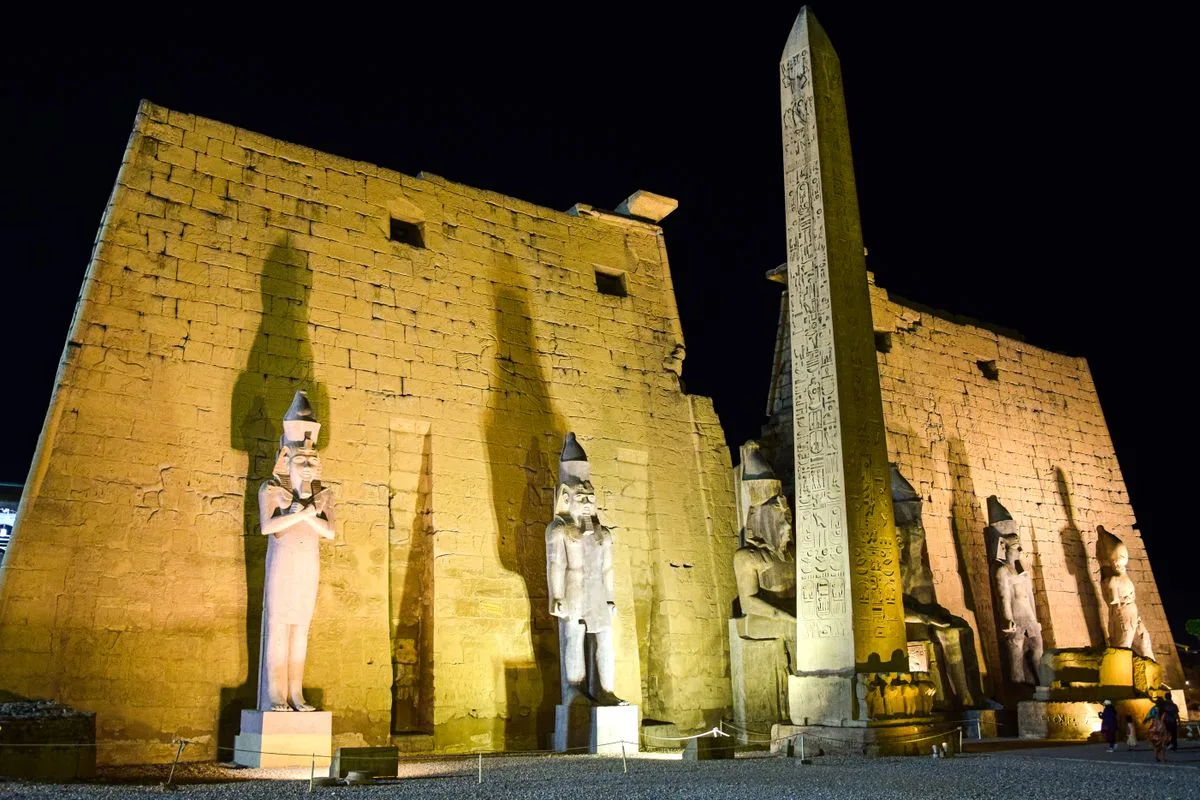
- The colossal statues of Ramesses II — seated giants flanking the first pylon, with Nefertari carved small at his feet.
- The Colonnade of Amenhotep III — fourteen columns 19 metres tall, their walls showing the Opet Festival procession.
- Alexander the Great’s chapel — the Macedonian conqueror rebuilt an inner sanctuary and had himself carved as a pharaoh before the gods.
- The Abu Haggag Mosque — perched high inside the temple, still in daily use after eight centuries.
Ready to walk the colonnade under the floodlights? Our private Karnak & Luxor Temple tour can be timed for the evening glow.
The Obelisk With a Twin in Paris
Stand before the first pylon and you will notice the entrance is oddly lopsided — one tall pink-granite obelisk on the right, an empty base on the left. The missing twin is not destroyed. In 1830 it was gifted to France, shipped down the Nile and across the sea, and today it stands in the Place de la Concorde in Paris, one of the most famous monuments in Europe. For a practical traveler overview of the city, see Lonely Planet’s Luxor guide. The two obelisks that once framed this doorway together are now 3,000 kilometres apart — a small, strange thread connecting Luxor Temple to a Paris roundabout.
Ahmed Abdel Hamid, our founder and licensed Luxor guide, tells his guests where the temple’s real secret hides: “Look at the Abu Haggag Mosque up in the corner. When it was built about 800 years ago, the temple was buried almost to the rooftops in sand and rubble — so the mosque door sits high on the wall, at what was then ground level. As archaeologists dug the temple back out, the mosque was left hanging in the air. It is the only place in Egypt where you can literally see 800 years of buried history measured on a single wall.”
Why Luxor Temple Is Best After Dark
Most Egyptian temples close at sunset. Luxor Temple stays open late, and that changes everything. Under floodlights the columns throw huge shadows, the crowds thin, and the heat of the day lifts off the stone. The carvings that vanish into glare at noon come alive in the low, warm light. If you see only one monument at night in Egypt, make it this one.
Building a full Luxor day? Pair the temple with mighty Karnak Temple and the West Bank Valley of the Kings — all in our Luxor day tours. For a dawn view from above, add a sunrise balloon flight.
FAQs About Luxor Temple
Why does Luxor Temple feel so different from other Egyptian temples?
It was not a tomb or a single god’s house — Luxor Temple was dedicated to the renewal of royal power, the stage for the yearly Opet Festival when the king’s divine right was ritually recharged.
Where is the missing twin of the Luxor Temple obelisk today?
It has stood in the Place de la Concorde in Paris since the 1830s, a gift from Egypt to France — which is why only one of the original pair remains at the temple entrance.
Is the mosque built inside the temple still used?
Yes — the Abu Haggag Mosque has held prayers for roughly 800 years and remains active today, an unbroken layer of living worship stacked on ancient stone.
What is the best hour to see the temple lit up?
Arrive about an hour after sunset: the floodlights are at full effect, day-trip crowds have gone, and the evening cool makes the long walk between the columns a pleasure.
Why Luxor Temple Ends the Day Perfectly
A pharaoh’s stage, an obelisk with a Parisian twin, and a mosque suspended over 800 years of history — Luxor Temple is a monument you feel more than tick off, and it saves its best for the evening. Message us on WhatsApp to plan your evening visit.
