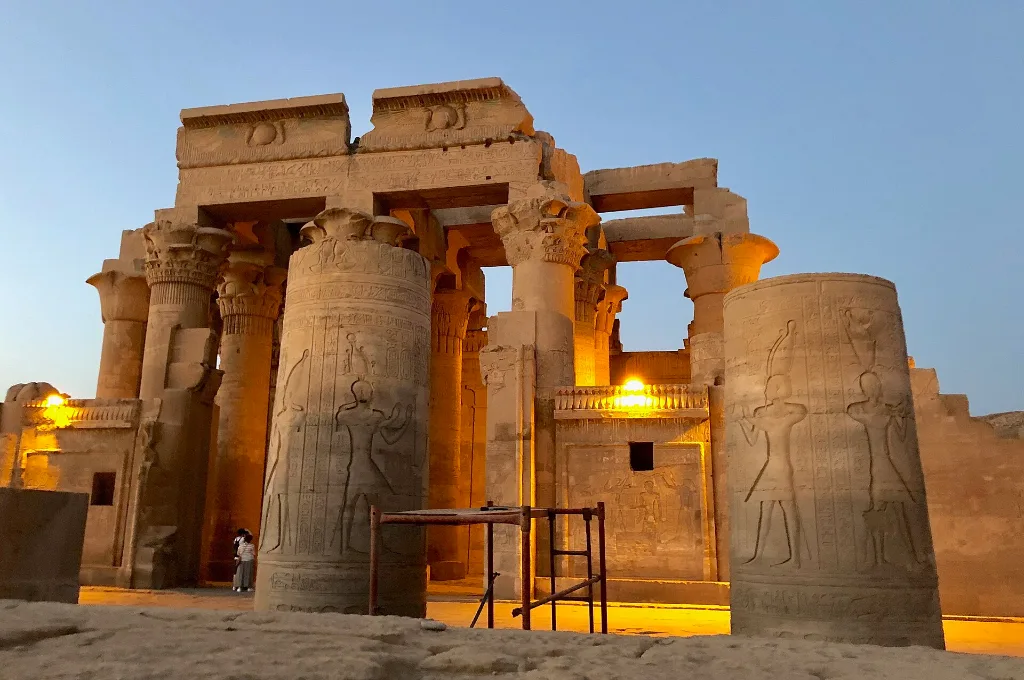
What if one temple served two gods at the same time? At Kom Ombo Temple, every gateway, hall and sanctuary comes in a pair. The Nile glows beside it at sunset.
Why Does Kom Ombo Temple Have Two of Everything?
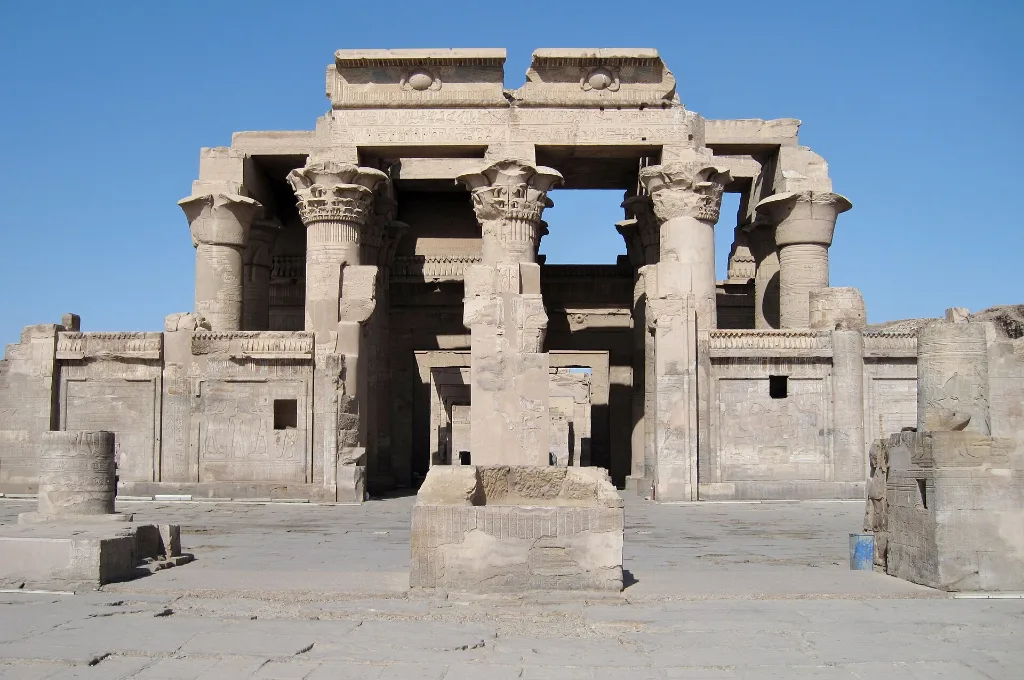
Because two gods shared one roof. The temple honours Sobek, the crocodile god, and Horus the Elder, the falcon god. Each has his own entrance, court, hall and sanctuary, mirrored down the centre line.
The Ptolemies built it on a rise above the river. Sobek rules the right-hand side. Horus the Elder holds the left. Walk down the middle and you walk the line between them.
- A true twin design, duplicated from gate to sanctuary.
- A Crocodile Museum with mummified crocodiles.
- Reliefs many read as ancient surgical instruments.
Why Did the Ancient Egyptians Choose This Exact Bend in the Nile?
Tradition points to the crocodiles. Sandbanks here were a favourite basking place, so the river itself seemed to belong to Sobek. The mound (“kom”) above the water kept the temple safe from the flood.
Put the two together and the site makes sense. A sacred riverbank, a high platform and a bend that catches the evening light.
What Is Worth Your Time Inside Kom Ombo Temple?
Three things: the doorways, the carved walls and the Crocodile Museum. Give each a few minutes and the hour passes quickly. Do not skip the outer wall. Its reliefs are less crowded, and the carved scenes there are easy to read.
The twin doorways and halls
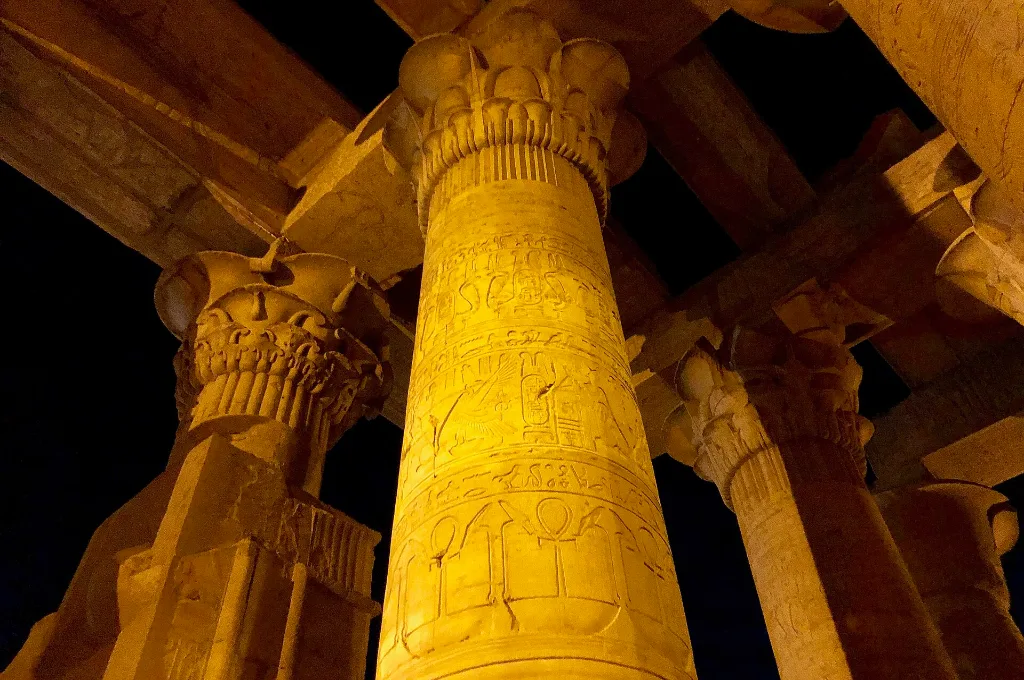
Look at the entrance and count the doors. The paired design continues in the halls, where palm-style columns frame the sky. The stone turns amber as the sun drops.
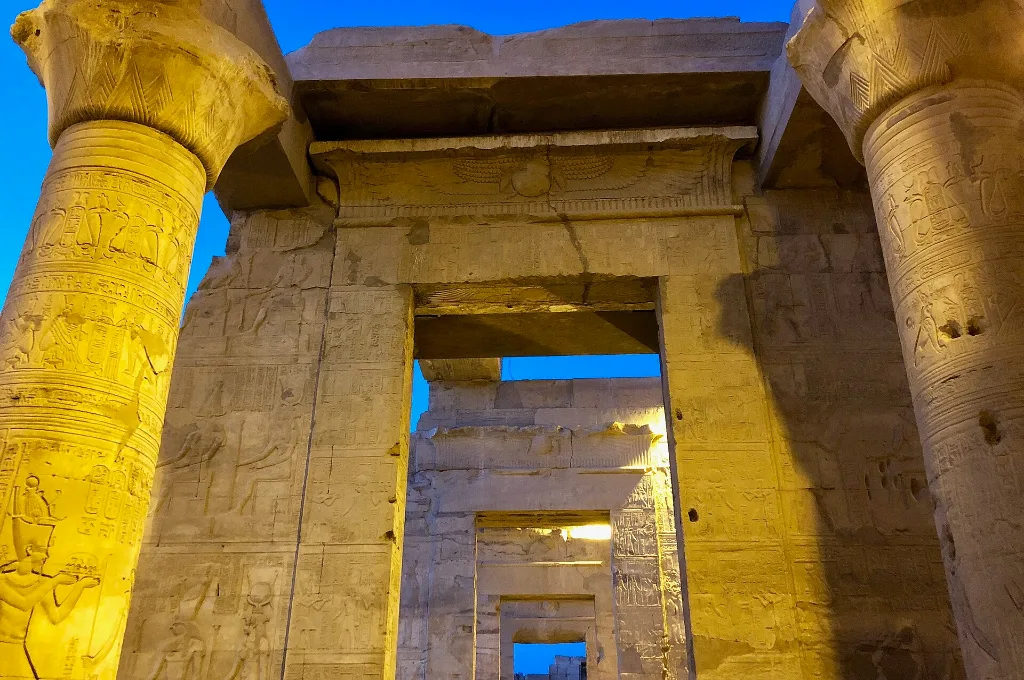
The wall carvings, tools and calendar
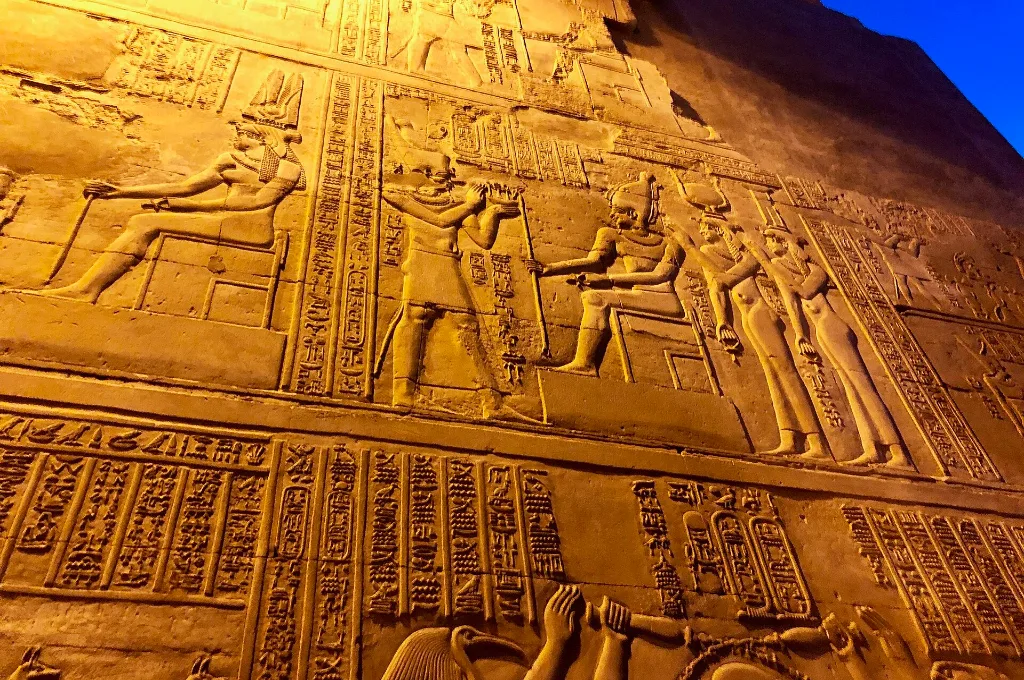
Carved panels show gods, kings and offerings in crisp relief. One famous scene shows a set of tools that many read as surgical instruments. Scholars still debate it, so ask your guide what they think.
Expert tip: step back from the walls. Late light makes shallow carvings stand out, and the best photographs happen from a few metres away.
The Crocodile Museum
Small, dark and a little macabre. Rows of mummified crocodiles from the sacred pools lie here, from hatchlings to giants. Locals saw them as the earthly forms of Sobek.
How Do You Plan a Visit to Kom Ombo Temple?
Arrive in the late afternoon. Most Luxor to Aswan cruises stop here around sunset, and the river views are the best of the day. The air is cooler too, so a light layer helps once the sun drops. Kom Ombo is paired with Edfu on day 3 of our 4-night Luxor to Aswan cruise, and on day 2 of the 3-night cruise sailing the other way.
| Visit detail | What to know |
|---|---|
| Location | Riverbank at Kom Ombo town, about 45 km north of Aswan |
| How you visit | Nile cruise stop or a road trip from Aswan |
| Time needed | About 1 hour, plus 20 minutes for the museum |
| Best light | Sunset, when the columns turn amber |
Ready to see the columns glow? Explore our Nile cruises and time your stop for sunset. For background on the site’s story, see this overview from History Hit.
Which Nile Stops Pair Best With Kom Ombo Temple?
Edfu in the morning and Kom Ombo at dusk. Edfu Temple gives you completeness. Kom Ombo gives you atmosphere.
Add a gentle felucca ride in Aswan and a visit to Elephantine Island, where another Khnum shrine stands. Our guide to things to do in Aswan fills the rest of your days. Browse Luxor tours and Aswan tours, or start in the capital with our 7-day itinerary through Cairo, Luxor and Aswan.
Kom Ombo Temple: Quick Answers From Our Guides
Which half of Kom Ombo Temple belongs to Sobek?
The right-hand side. Horus the Elder holds the left. Your guide can point out the matching doors and altars on each side.
Where should you stand to photograph Kom Ombo Temple at sunset?
Face the river from the terrace beside the temple, or step back into the court for a framed shot through the columns. Arrive 30 minutes early for the best spot.
Why did ancient Egyptians honour the crocodile?
The crocodile stood for strength, fertility and the river’s power. Honouring Sobek was a way to keep the animal calm and the Nile generous.
Do the crocodile mummies at Kom Ombo look real?
Yes. They are real mummies from the sacred pools, wrapped and preserved in the dry desert air. The museum is small, so five to ten minutes is enough.
Two Gods, One Unforgettable Evening
Kom Ombo Temple rewards a slow, late-afternoon visit. Count the doors, look for the carved tools and watch the stone turn gold. Tell us your dates and we will place it at sunset on your sailing.