
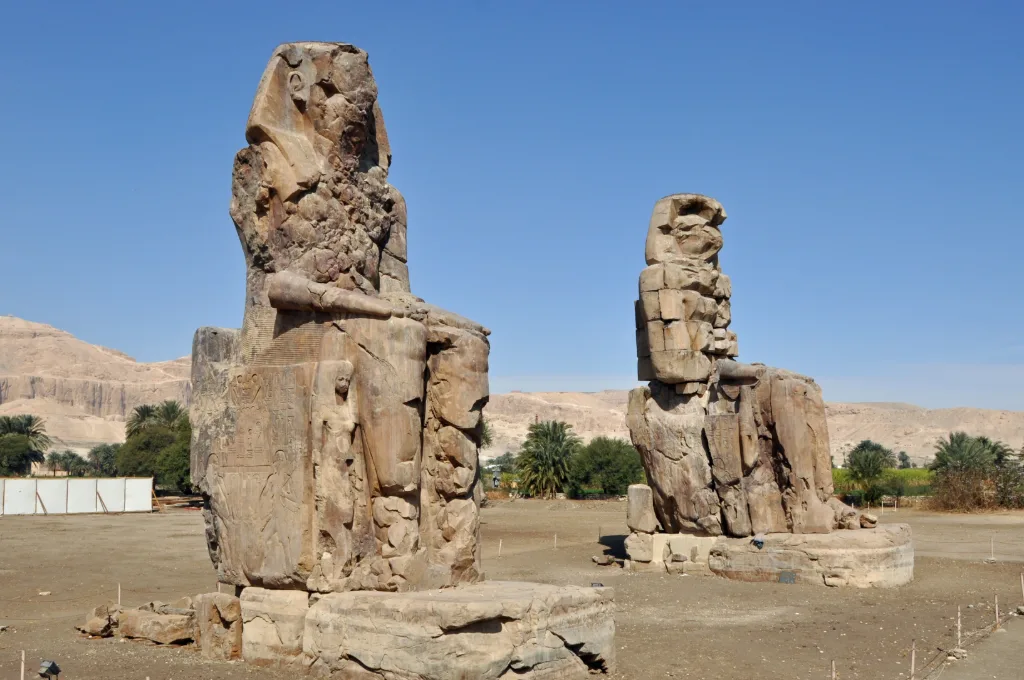
Is a pair of stone giants really worth a stop on the road to the Valley of the Kings? The Colossi of Memnon cost nothing, take ten minutes and carry one of Egypt’s strangest stories. Here is how to see them at their best, and why “singing statues” once drew Roman crowds.
What Exactly Are You Looking At?
Two seated portraits of Pharaoh Amenhotep III, each about 18 metres tall. They once guarded the entrance to his vast temple on the West Bank.
- Small figures of his wife, Tiye, and his mother, Mutemwiya, stand beside the legs.
- Side panels show Hapy, the god of the Nile.
- The stone is quartzite, quarried near modern Cairo and hauled hundreds of kilometres to Thebes.
The temple itself has almost vanished. Floods and later builders took it apart, and the giants kept watch alone.
The Statue That Sang Until a Roman Emperor Fixed It
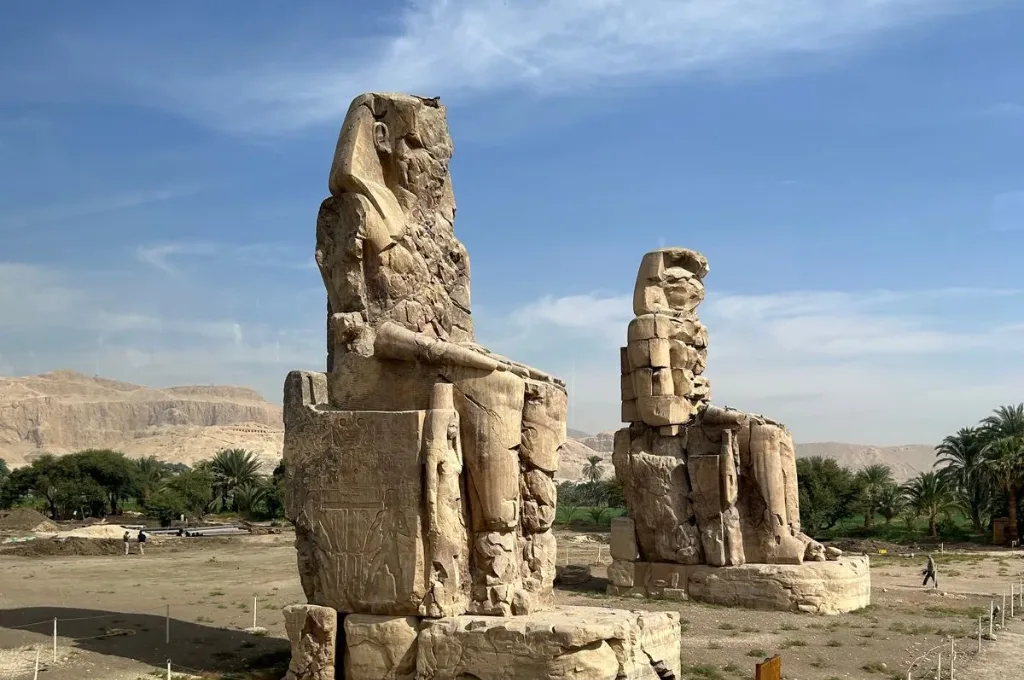
After an earthquake in 27 BC cracked the northern colossus, it began to hum at dawn. Greeks heard Memnon, the hero of the Trojan story, greeting his mother Eos, goddess of the dawn. The sound stopped after the emperor Septimius Severus had the statue repaired around AD 199.
Modern scientists offer a simpler answer. Dew trapped in the cracked stone warmed at sunrise, and the stone vibrated. It is a rare case where a legend and a physics lesson fit the same rock (the Atlas Obscura entry on the Colossi sums up the theory).
Curious about the rest of the West Bank? Explore our curated Luxor day tours and let a guide connect the dots: Luxor day tours.
Why Did Roman Tourists Carve Poems on a Leg?
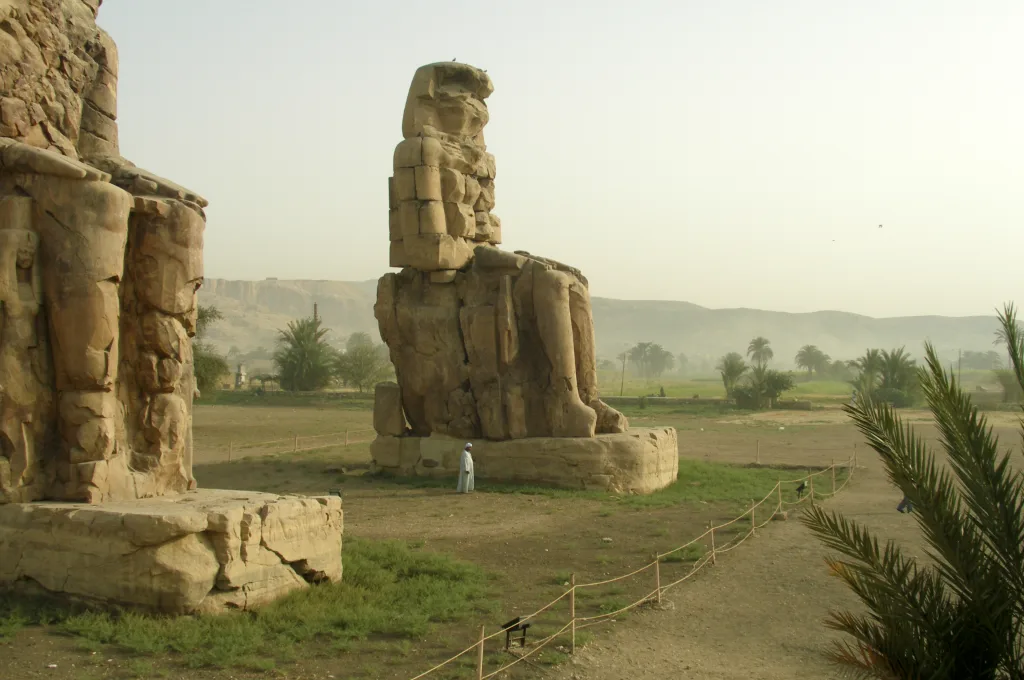
Because hearing Memnon was the ancient equivalent of a bucket-list trip. Visitors came from across the empire and signed the stone to prove it.
- More than a hundred Greek and Latin inscriptions cover the legs and base.
- Emperor Hadrian came in AD 130 with his wife, Sabina.
- The poet Julia Balbilla, in their party, carved her verses into the statue.
Our guides like to say the Colossi hold Egypt’s oldest travel reviews. Look closely at the lower legs, and you can still pick out some of the lettering.
Colossi of Memnon at a Glance
Short stop, no ticket, and no need to plan around opening hours.
| Detail | What to expect |
|---|---|
| Entry | Free, with no ticket office |
| Time needed | 10 to 20 minutes |
| Best light | Sunrise, or late afternoon |
| Where | West Bank, beside the main road to the Valley of the Kings |
| Good to pair with | Medinet Habu, the Ramesseum and Deir el-Medina |
What Does a Sunrise Visit Feel Like?
Quiet, cool and golden. Mist often hangs over the cane fields, the roadside stalls are still shut, and the two giants glow orange against pale cliffs. You share the view with a handful of photographers.
Field tip: stand on the road side, in front of the statues. They face east, so the rising sun lights their faces. Bring a light layer, because winter dawns are cool.
How Do You Fit Them Into a West Bank Day?
Treat them as a bookend, not a destination. Stop on your way out at dawn, or on your way back when the light turns gold.
- Early start: Colossi, then the Valley of the Kings before the crowds.
- Relaxed pace: Colossi, then Medinet Habu, a short drive south.
- Heat-smart in summer: skip midday and return at sunset.
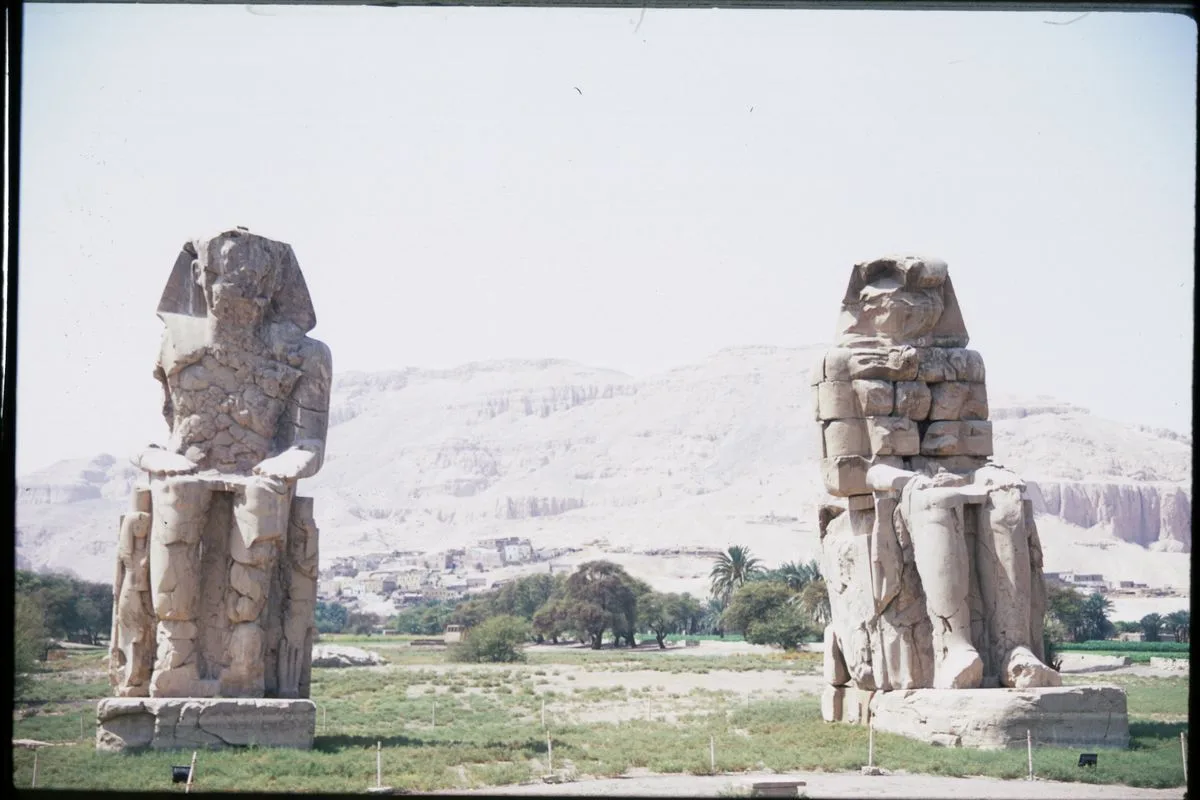
A white fence keeps visitors clear of the excavation behind the statues, where an international team has worked for years to uncover and re-erect pieces of the lost temple. Stay on the road side and enjoy the view.
Planning the rest of your days? Start with our things to do in Luxor guide, or see how the stop fits into Luxor in two days. Check what the other sites cost in our Luxor ticket prices guide.
Want the Colossi at sunrise with balloons drifting overhead? Add a hot air balloon flight to your Luxor stay through our Luxor balloon tour.
Colossi of Memnon: Questions Worth Asking
Do the Colossi of Memnon still sing?
No. The sound stopped after the Roman repair around AD 199, and nothing has been heard since.
Who was Memnon, and why do the statues carry his name?
Memnon was a hero of Greek myth. Greek and Roman visitors linked the dawn sound to him, so the name stuck, even though the statues show Amenhotep III.
Do I need a guide to enjoy them?
Not for the view. A guide helps if you want the inscriptions, the myth and the excavation explained in ten minutes.
Can I go inside the fenced area behind them?
No. It is an active excavation site, and a fence keeps visitors out. The best views are from the road side.
Ten Minutes, Two Thousand Years
The Colossi of Memnon ask for almost nothing and give back a great story. Stop at dawn, read the legs, and add Medinet Habu next door. Let us build your West Bank day with our Luxor tours.
Featured image: Marc Ryckaert (MJJR), CC BY 3.0, via Wikimedia Commons.