
How do you build a temple so vast that thirty pharaohs across two thousand years each added to it — and none ever declared it finished? That is Karnak Temple in Luxor: not one monument but a city of gods, the largest religious complex the ancient world ever raised.
Quick Answer: Karnak Temple sits on Luxor’s East Bank, dedicated mainly to the god Amun-Ra. It grew for roughly 2,000 years, covers over 100 hectares, and its Great Hypostyle Hall holds 134 towering columns. Allow 2–3 hours, arrive at opening for cool light, and pair it with Luxor Temple the same day.
Plan Your Visit: Karnak at a Glance
Everything you need before you step through the first pylon — timing, cost, and how long to stay:
| Detail | What to know |
|---|---|
| Location | Luxor East Bank, ~3 km north of Luxor Temple |
| Dedicated to | Amun-Ra, Mut and Khonsu (the Theban triad) |
| Opening hours | 6:00 AM – 5:30 PM (extended in summer); sound-and-light show after dark |
| Entry fee | From about EGP 450 for foreign visitors (check locally — prices change) |
| Best time | At opening or late afternoon; October–April for cooler days |
| Time needed | 2–3 hours to do it justice |
| Photography | Allowed everywhere; the hypostyle hall is best in low-angle morning light |
Where Should You Actually Walk First?
Karnak is too big to wander aimlessly. Follow the ancient processional line and prioritize in this order:
- The Avenue of Ram-Headed Sphinxes — the entrance approach, each ram sheltering a small statue of the pharaoh between its paws.
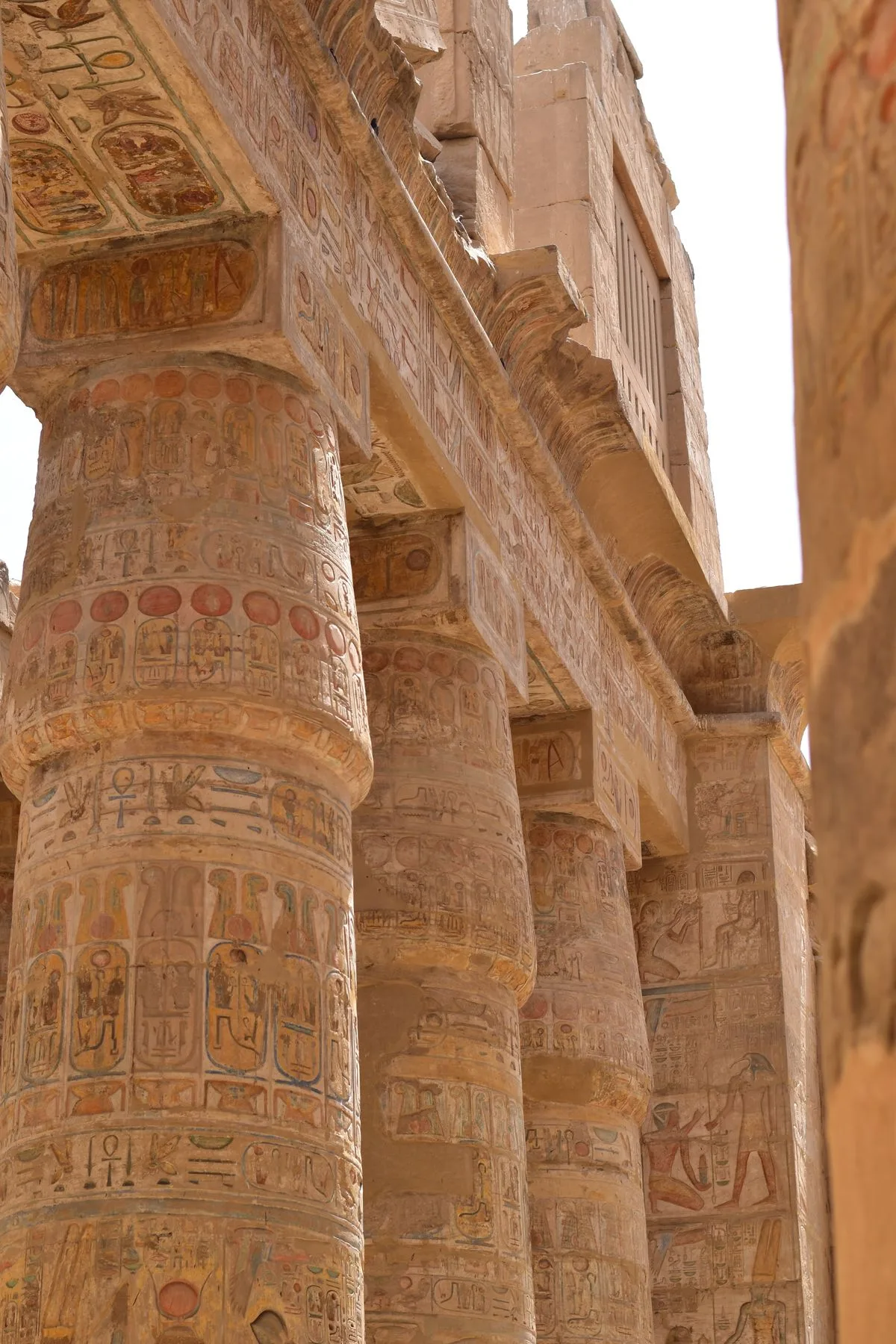
- The Great Hypostyle Hall — the heart of Karnak, 134 columns so massive that fifty people could stand on a single capital.
- The Obelisk of Hatshepsut — 30 metres of single pink granite, one of the tallest still standing in Egypt.
- The Sacred Lake — where priests purified before rituals; the giant stone scarab of Amenhotep III sits on its edge.
- The Cachette Court — where thousands of buried statues were discovered, hidden by priests over a millennium.
Ready to stand beneath the columns before the coaches arrive? Our private Karnak & Luxor Temple tour starts at opening time.
The Temple That Took 2,000 Years and Thirty Pharaohs
No single ruler built Karnak Temple. From the Middle Kingdom to the Ptolemies, each pharaoh who wanted to prove his devotion to Amun added a pylon, a hall, an obelisk, or a chapel — expanding the complex for nearly two millennia. That is why Karnak feels less like a building and more like a stone archive of Egyptian history, where you can walk from one dynasty to the next in a few hundred metres. For the full construction timeline, Britannica’s Karnak overview is a solid academic reference. Seti I and Ramesses II raised the Hypostyle Hall; Hatshepsut and Thutmose III added their obelisks; even Alexander the Great’s successors left their mark.
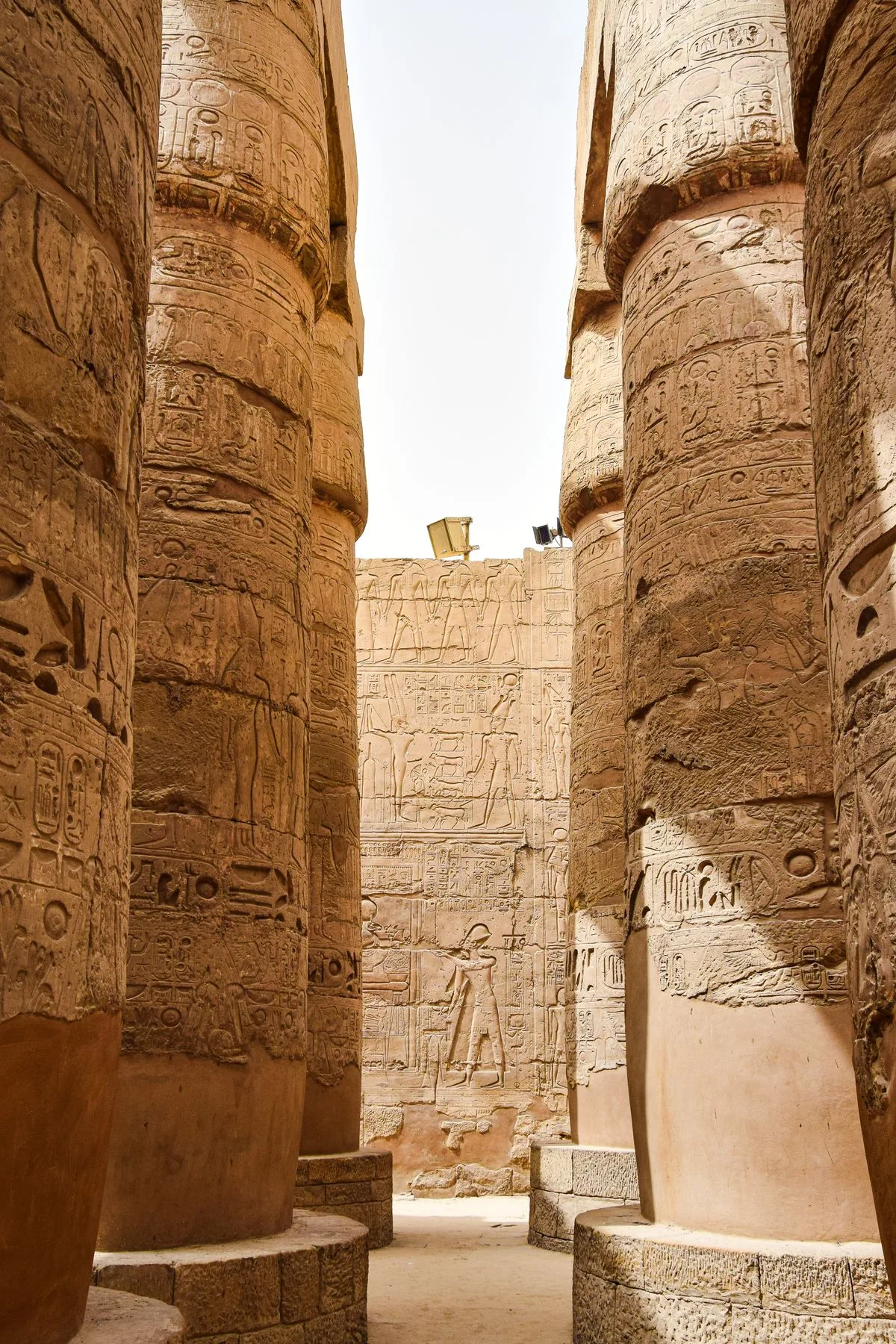
Ahmed Abdel Hamid, our founder and licensed Luxor guide, shares what most visitors rush past: “Everyone looks up at the columns — and they should. But look down at the base of the second column on the left in the Hypostyle Hall. You can still see the original blue and red paint, protected from the sun for 3,000 years. People walk over it a thousand times a day without noticing that Karnak was once painted in blazing colour, not bare sandstone. When I show my guests that one spot, the whole temple changes in their eyes.”
Karnak After Dark: The Sound and Light Show
When the sun sets, Karnak becomes theatre. The pylons and columns are lit in shifting colour while a narrated walk through the complex tells the story of Thebes and its god-kings, ending at the Sacred Lake. Shows run in several languages each evening, so confirm the English schedule ahead. Seeing the hall lit at night, after walking it by day, is a completely different experience.
Doing the whole East Bank in a day? Most travelers combine Karnak with Luxor Temple and finish across the river at the Valley of the Kings — see all our Luxor day tours.
FAQs About Karnak Temple
Why did pharaohs keep expanding Karnak for two thousand years?
Adding to Karnak Temple was the ultimate act of royal piety — each ruler proved his bond with Amun-Ra, the state god of Thebes, by leaving a permanent mark, so the complex simply grew with every reign.
What actually happens at the Karnak sound and light show?
You walk through the lit complex while narration and music tell the story of Thebes, ending seated by the Sacred Lake for the finale — about an hour in total, in rotating languages.
Can you still walk the Avenue of Sphinxes between Karnak and Luxor Temple?
Yes — the ancient 2.7 km processional road was fully reopened in 2021, and you can now trace the same route the gods’ statues once travelled during the Opet Festival.
When is the best light for photographing the Hypostyle Hall?
The first hour after opening, when low sun rakes between the columns and casts long shadows down the aisle — the same light that reveals the surviving paint near the column bases.
Why Karnak Anchors Any Luxor Trip
Karnak is not a temple you tick off in twenty minutes — it is two thousand years of ambition carved in stone, best read slowly and with someone who knows where to look. Give it a morning, and it becomes the highlight of Luxor. Message us on WhatsApp to plan your private Karnak morning.